Transformation Memoir · The book
The Minstrel Perspective
The Minstrel Perspective is the story of what six decades inside the rehearsal room, the sanctuary, and the mentor relationship actually teach a person about worship. Professor Belton traces his journey from a three-year-old drawn back to a piano while his siblings walked away, through live recordings in Philadelphia and London, to the dual directorship of two congregations, and into the silence COVID forced on choirs across the country. This is not a how-to manual. It is a living philosophy, arrived at through living.
At the heart of the book is one non-negotiable conviction: anointing and skill are inseparable, and a worship leader who has been entrusted with a gift is responsible for developing it, sharing it, and ultimately pouring it out completely. The Minstrel Perspective is for every worship leader, choir director, musician, and psalmist who wants to stay ahead of the curve and leave nothing behind.
Get your copy
Buying links will appear here at launch. Read a free chapter in the meantime.
The central idea
Six decades of music ministry prove that worship excellence is built on the inseparable union of anointing and skill, sustained through intentional mentorship across generations - and that every worship leader's assignment is to pour out completely what God has placed in them, leaving nothing behind.
Free chapter
Try before you buy
Get Chapter One as a typeset PDF, sent straight to your inbox.
Enter your email to get Chapter One. One email with your download, unsubscribe anytime.
Inside the book
Chapter by chapter
01 Dedicated: The Roots That Made Me +
The roots that formed everything: a deacon father, a ministry-minded mother, and a three-year-old who kept returning to a piano while his siblings walked away.
02 The Minstrel's Perspective: How I Learned to See +
The foundational lens of the entire book - the Minstrel's perspective - not as an imported framework but as a philosophy arrived at through six decades of living.
03 Those Who Shaped the Shaper +
The pastors, mentors, and relationships that shaped Wilbur before he ever shaped anyone else, and what their voices, corrections, and opportunities built in him.
04 The Lesson Plan Before the Lesson +
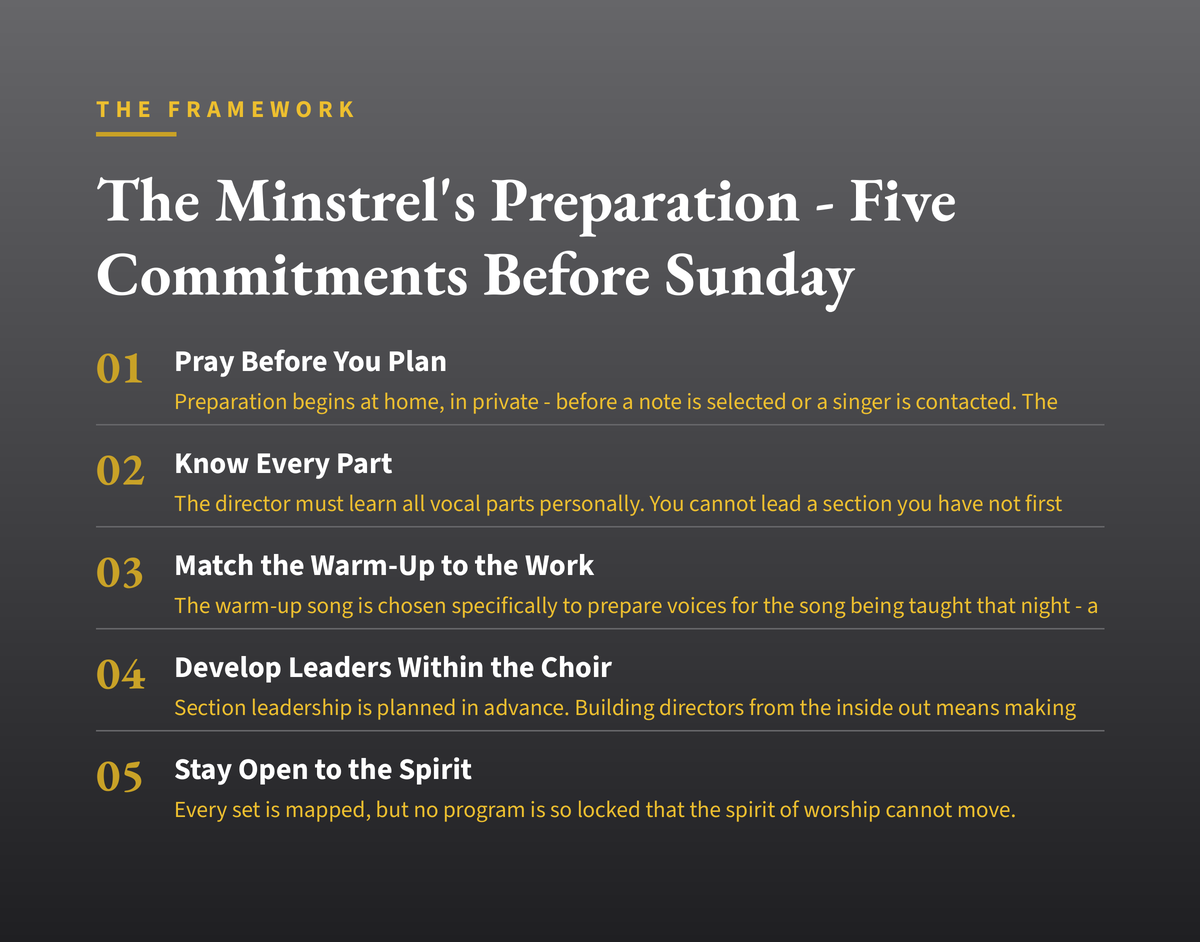
What happened before the choir arrived: prayer, learning all vocal parts, selecting the right warm-up, planning section leadership, and mapping the full musical set.
05 In the Rehearsal Room: The Sunday the Pastor Could Not Preach +
The lived texture of twice-weekly rehearsal work - what it cost, what it produced, and the Sunday when spirit-led praise moved so powerfully that the pastor could not preach.
06 Building the Directors: Leadership from the Inside Out +
The expansion from shaping singers to shaping the leaders of singers - what it took to develop not just musicianship but the authority and preparation of a choir director.
07 The Message Is Jesus, Not the Musician +
The hardest conversation in ministry: the private meeting with a singer showcasing their voice rather than ministering with it, and the tension between gift and ego.
08 Programmed vs. Spirit-Led: The Technology Tension +
The slow creep of technology into the sanctuary - earpieces, programmed cues, locked services - and what that costs the spontaneous, spirit-led flow of worship.
09 The Real Test of Leadership: Two Churches, One Voice +
What it looks like from the inside to serve as director of worship sacred arts at two churches simultaneously, and what integrity that dual calling demands.
10 Stellar Anomaly: When the Music Went on Record +
Two recordings that mark the outer edges of the ministry: the Come Bless His Name live album in Philadelphia and a live recording on a London stage.
11 The Faces of a Living Legacy +
The faces of the legacy: students who became worship leaders and directors, carrying the teaching - and the philosophy - into their own sanctuaries.
12 When the Music Went Silent +
COVID silenced the choirs. This chapter lives inside that rupture - the emotional weight, the virtual pivot, and the six-to-nine-month climb back to a singing congregation.
13 Rebuilding in the Post-COVID Era +
The harder work after the silence: rebuilding choirs, re-engaging singers, and rethinking what rehearsal and worship community could look like in a changed world.
14 Proof of the Work: Awards and the Weight of Recognition +
The awards received across the career - not displayed but examined, each recognition becoming a window into the stretch of work and sacrifice that stood behind it.
15 Die Empty: A Charge to the Next Generation +
On the threshold of his seventieth birthday and sixtieth year in ministry, a final charge to the next generation: pour it all out, leave nothing behind, die empty.
The framework
The Minstrel's Preparation - Five Commitments Before Sunday
Ask the book
Questions this book answers
Why does Professor Belton insist that anointing and skill must grow together?+
The Minstrel Perspective argues that separating the two produces worship that is either emotionally loud without substance or technically correct without spirit. Six decades of rehearsal work showed Professor Belton that vocal discipline and spiritual preparation are not in competition. The rehearsal room is where both are built, simultaneously, before Sunday ever arrives.
Chapter 2
What did Professor Belton do before a single singer walked into rehearsal?+
Before the choir arrived, he prayed at home, learned all vocal parts himself, selected a warm-up song specifically matched to the song being taught, planned which section leaders would carry which moments, and mapped the full musical set. The rehearsal room was only the visible portion of a preparation process that began much earlier and required that kind of intentionality every time.
Chapter 4
How do you correct a singer who is showcasing their gift rather than ministering with it?+
Professor Belton addressed this in a private meeting rather than in front of the choir, a choice that protected the person's dignity while making the correction unavoidable. The conversation required distinguishing between what the voice could do and what the assignment actually called for. The message of the ministry is always Jesus, not the musician, and that distinction has to be instilled directly and personally.
Chapter 7
What is the real cost of technology-driven worship, and how did Professor Belton navigate it?+
When musicians depend on earpieces and cues, and when services are locked to a program, the spontaneous flow that once characterized spirit-led worship becomes difficult to sustain. Professor Belton's reckoning with this tension was not a rejection of technology but a refusal to let it replace the preparedness and flexibility that genuine worship demands. Making sure the spirit of a service could move freely was always the priority.
Chapter 8
What did rebuilding after COVID actually look like for a working choir director?+
COVID forced a technology leap that many congregations were not prepared for, and the silence it created lasted well beyond the shutdown itself. The rebuilding period stretched six to nine months as congregants found their way back to in-person worship and singers rediscovered their voices. Professor Belton navigated that process not as a recovery plan but as the lived, week-by-week work of a ministry finding its voice again in a changed world.
Chapters 12 and 13
What does 'die empty' mean, and why does Professor Belton end the book with it?+
Die empty is the charge Professor Belton extends to the next generation of worship leaders as the book closes on the threshold of his seventieth birthday and sixtieth year in ministry. It means that every gift, every lesson, every hard-earned piece of understanding was meant to be poured out completely, passed forward, and left with the people who will carry the ministry next. Nothing withheld. Nothing buried. Nothing left behind.
Chapter 15
Both of my parents helped groom that music ministry in me because I had to use that talent in my church.